Most webcams sit on top of your monitor and make you look like you're staring at someone's forehead. The FlexCam 10 tries something different.
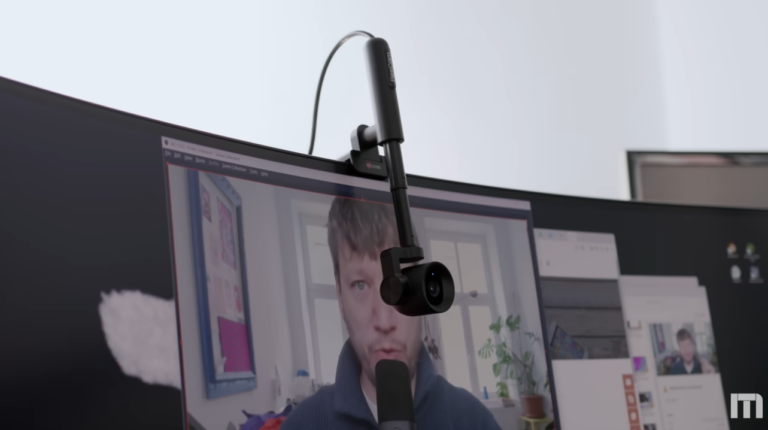
If you spend your workday on video calls, you already know the awkward truth: the camera on top of your monitor captures you looking slightly downward, away from the person you're talking to. The result is a conversation where nobody quite feels looked in the eye. The FlexCam 10 from Joyusing is built around a simple mechanical fix for this—and two features in particular, Center Camera and Eye to Eye, are what make it worth a closer look.
A reviewer who has used everything from budget no-name cameras to high-end models put it plainly: most webcams are basically the same, with slightly better resolution or autofocus but the same fundamental design . The FlexCam 10 is different not because its image quality is revolutionary—it delivers solid, usable 4K—but because its physical design changes how you position the camera, and therefore how you appear on screen .
The Center Camera concept is straightforward but surprisingly rare. Instead of clipping the webcam to the top edge of your monitor, the FlexCam 10 uses a telescopic arm and a rotating head to position the lens closer to the center of your screen . The camera head can rotate freely and tilt downward roughly 90 degrees, and the arm extends to bring the lens forward .
Why does this matter? Because when the lens sits along the center line of your display, you can look at the person on screen and be looking much closer to the camera itself. The awkward offset between “looking at the video” and “looking at the lens” shrinks. Joyusing describes this as a Center View mode designed for “close-up connection,” and the company's reasoning is sound: eye contact amplifies engagement and fosters trust .
The Eye to Eye mode is the practical payoff of the Center Camera design. By rotating the camera and positioning it along the center of the screen—rather than perched on top—the lens ends up much closer to your natural line of sight during a call . A hands-on reviewer described the effect as creating “a much more natural feeling that you're actually looking at the person you're talking to” .
This is not a software trick that digitally shifts your pupils. It is a mechanical solution: move the camera to where your eyes already are, and the problem mostly disappears. For anyone who has sat through a call wondering why the conversation feels slightly off, the difference is noticeable.
The FlexCam 10 backs up its positioning tricks with capable hardware. It shoots 4K at 30fps with a Sony 1/2.55″ sensor, and its PDAF autofocus keeps focus sharp across a 0.65–10 ft range . The 79° field of view is a sensible middle ground—wide enough for a comfortable seated frame without pulling in too much background . Dual noise-cancelling microphones handle audio with a pickup range up to 10 feet .
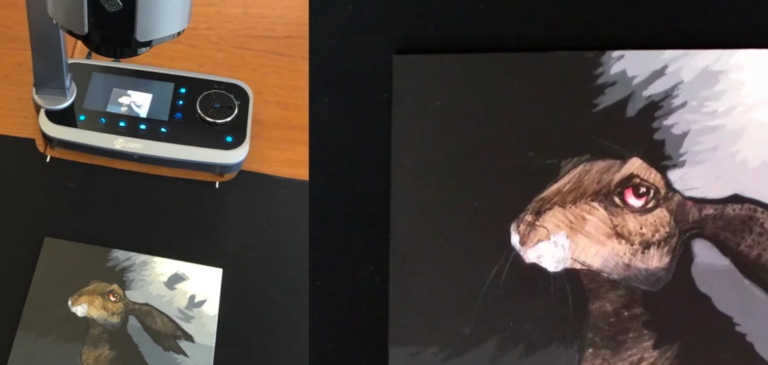
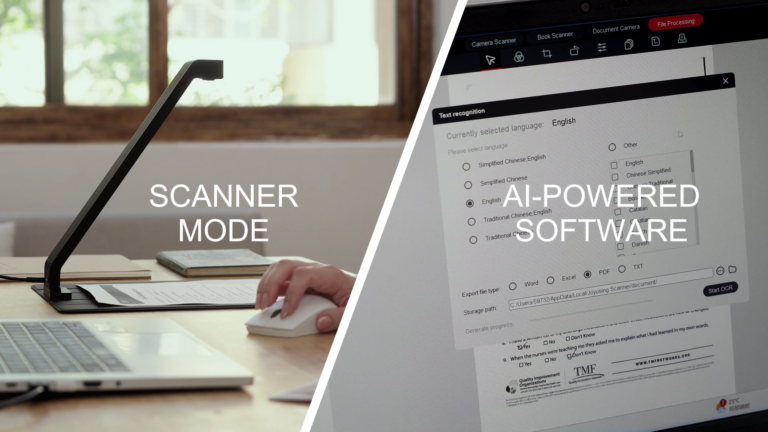
There is also a genuinely useful bonus mode: tilt the camera head downward and it becomes a makeshift document camera for showing paperwork, sketches, or notes during a call . And for privacy, the camera can simply be rotated toward the screen when not in use—no sliding shutter required .
One reviewer noted a trade-off worth mentioning: while the Eye to Eye positioning works as intended, not everyone will love having the camera sitting directly in front of what they're looking at or working on . It is a design choice, and for some users the benefit will outweigh the adjustment.
The FlexCam 10 is not aimed at someone who takes one or two calls a week and doesn't mind looking at a forehead. It is for people who spend meaningful time on video—remote workers, teachers, client-facing professionals, streamers—and who have noticed that the medium itself creates a small but persistent barrier to connection. The Center Camera and Eye to Eye features address that barrier directly, with a physical design rather than a software promise.
At a time when most webcams are incremental upgrades to the same formula, the FlexCam 10's willingness to rethink where the camera sits—and therefore what the other person sees—is a genuinely practical innovation.



United States (English)

France (French)

Portugal (Portuguese)

Spain (Spanish)
No.20 Building, Haixi Innovation Science Park, Wulongjiang Central Avenue, High-tech District, Fuzhou, Fujian 350108, China.